Rare Disease Day 2026: Many Voices, One Global Movement
Since 2015, the aHUS Alliance Global Action team has been right there alongside patients and caregivers—creating resources, sharing knowledge, and putting a spotlight on the issues that matter most to families navigating life with atypical hemolytic uremic syndrome (aHUS). Over these years, we’ve watched a truly global community take shape, and we’ve seen understanding grow around a disease that affects so much more than just physical health.
aHUS touches everything. The shock of diagnosis. The long-term decisions about work and family. The questions about what the future holds. The journey is complex and demanding, and every family walks a unique path. But here’s what we know across continents and cultures: no one facing aHUS is truly alone.
As Rare Disease Day 2026 approaches this February 28th, we’re taking a fresh approach—one that opens the door wider than ever for new ideas, new voices, and new forms of action.
If Not You, Then Who?
Here’s the honest truth: for years, a small handful of dedicated volunteers have carried much of the weight of aHUS advocacy. They’ve given generously—their time, their creativity, their energy. And we’re deeply grateful for this international group of people, who are aHUS patients and family caregivers themselves. But the work is bigger than any one person or small group, and it’s vital to keep growing with new ideas and innovative efforts in order to meet aHUS challenges.
To mark world Rare Disease Day 2026 we’ll break from our usual video project and try something new. This year, we’re inviting everyone—patients, caregivers, healthcare professionals, researchers, and supporters around the world—to step forward with your own projects and perspectives.
Advocacy doesn’t require a camera, a stage, or a spotlight. Rare disease advocacy is not centered on personal storytelling – instead, it transforms our experiences into shared understanding, helping others recognize common challenges and the strength it takes to live with a rare condition. It’s choosing to act with impact —and together. Self-advocacy and community advocacy go hand in hand, and both grow stronger when more people bring their creativity and lived experience into the conversation.
So we’re asking: What information about atypical HUS should people know, and how/where can they find this? What do you see as the common challenges for people affected by aHUS, by age group or region? What gaps exist – in knowledge, key information for the public, in medical services? Where could awareness, actions, or information make a real difference- and what are some realistic ways in which they can be achieved?
Here are just a few ways you might get involved:
*Use visual creativity—art, graphics, or photography—to express themes of resilience and connection
*Share aHUS research publications & Visual Abstracts of studies on social media
*Create infographics from aHUS facts. Feel free to make visuals utilizing our resources: 2025-Sept-2026 Fact Sheet or Know aHUS: Know Us (available in EN & 3 other languages)
*Ask your workplace, school, or community group to sponsor a blood drive, and encourage friends to do the same
*Contact your hospital, clinic, city or local organizations to take part in the global chain of lights through the “Light Up for Rare” initiative – an official Rare Disease Day event.
*Create a resource that other aHUS patients and their families would find helpful. Share it, become a mentor.
*Participate in Rare Disease Day activities, locally or online via social media, and help atypical HUS awareness by making our condition and needs more visible. (use our aHUS Info Center resources – below)
Every action, large or small, helps shape a broader, more inclusive advocacy landscape. Fresh ideas aren’t just welcome—they’re needed. Your voice matters. Your perspective is valuable. And our global aHUS community needs what you have to offer.
Rare Diseases: Collectively, Not So Rare
A rare disease is often defined as one that affects a small number of people individually—but when you look at the bigger picture, rare diseases are anything but rare. Globally, more than 300 million people live with one of over 6,000 identified rare diseases. Families everywhere face strikingly similar challenges: delayed diagnoses, limited treatment options, and the ongoing need for broader awareness and understanding.
aHUS is part of this larger story. By linking arms with the global rare disease community, we strengthen visibility, accelerate learning, and reinforce a crucial message: rare disease patients matter—everywhere.
What Exactly Is Rare Disease Day?
On February 28, 2026, people around the world will unite to raise awareness for rare diseases like atypical HUS. Observed each year on the last day of February, Rare Disease Day brings together patients, families, clinicians, researchers, policymakers, and organizations to focus attention on rare conditions and their real-world impact.
Launched in 2008 by EURORDIS, Rare Disease Day has grown into a truly global movement—one fueled by collaboration, compassion, and shared purpose.
The aHUS Alliance is an informal umbrella group connecting aHUS advocates and patient organizations across more than 30 nations. Recognized as a charitable non-profit (legal registration No. 1167904), the aHUS Alliance Global Action team supports collective advocacy by creating articles, graphics, and educational materials that highlight key issues within the atypical HUS community.
Explore, Share, and Create
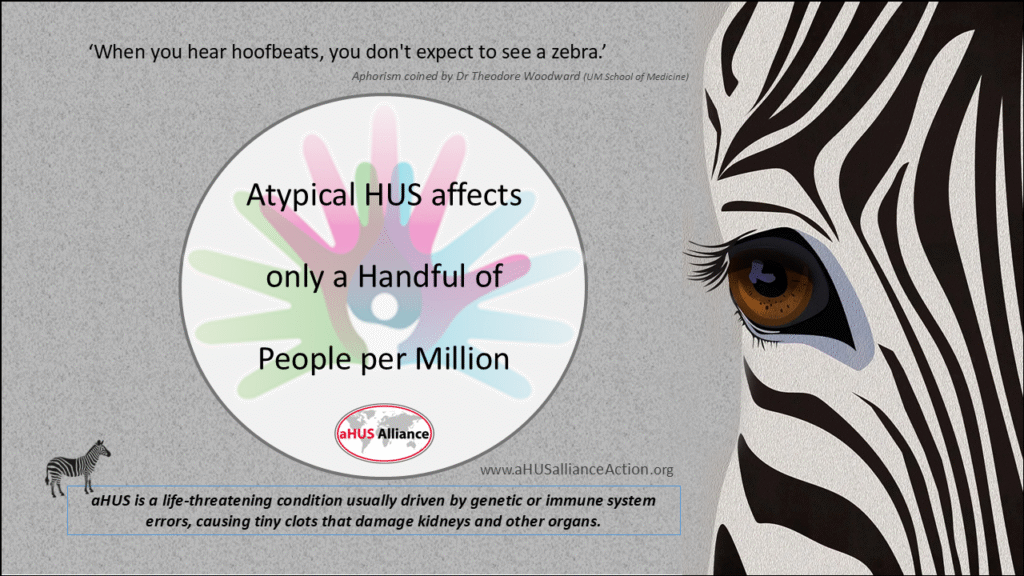
Our Rare Disease Day Images & Graphics Gallery features original content created by the aHUS Alliance Global Action team over the years. These materials—and many others—are available in the Info Centre’s Rare Disease Day & aHUS Awareness Day section, alongside past projects and advocacy resources.
Rare Disease Day – Image Gallery Promote aHUS Awareness with this shareable link: https://bit.ly/aHUSimages4RareDay
As we look ahead to Rare Disease Day 2026, the invitation is simple: bring your ideas, your skills, and your energy. Advocacy thrives when creativity is shared—and when many voices rise together.
Rare disease awareness is strongest when it belongs to everyone.
While social media posts and hashtags are powerful for awareness, they don’t notify us—and as a small volunteer-led team of patients and caregivers, we regret to say that we don’t have the bandwidth to search platforms or monitor hashtags. Unfortunately we’re also unable to accept or review large files or video submissions, for the same reasons.
After Rare Disease Day, we would love to recognize and share the many creative efforts happening around the world. If you organize or participate in a project, please email a brief description of your efforts to Info@aHUSallianceAction.org, along with a direct web link (URL) if the content is posted online. We’re planning a follow-up website article celebrating the collective impact of Rare Disease Day advocacy around the world—and we’d love to feature emails from aHUS supporters in many countries sharing how you brought these goals to life.
(Please note: While social media posts and hashtags are powerful for awareness, they don’t notify us—and as a small volunteer-led team of patients and caregivers, we regret to say that we don’t have the bandwidth to search platforms or monitor hashtags. To help us manage submissions, please note that our email system can’t accept large files or videos. We’re deeply grateful for your patience and support as aHUS Alliance Global Action is fully an all-volunteer organization.)
Rare Disease Day – aHUS Info Center Resources
Rare Disease Day – IMAGES & Graphics Gallery (Original Content, created by the aHUS Alliance Global Action team). Promote aHUS Awareness with this shareable link: https://bit.ly/aHUSimages4RareDay
aHUS Image Gallery – Informational & Advocacy Images
Visit our Info Centre’s tab for Rare Disease Day & aHUS Awareness Day HERE, for a wide array of past projects as well as other resources.