
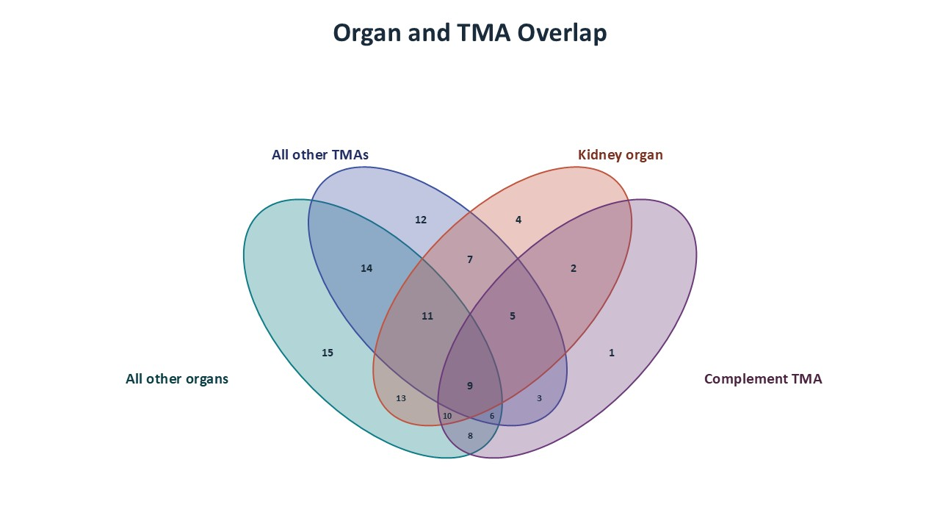
This complex illustration covers all the main elements of thrombotic microangiopathies, and body organs affected by them.
They include complement TMA and all other TMAs which are not complement and the kidney organ as well as all the other body organs which can be damaged.
The 4 elements do not intersect in four places – 1 , 4, 12, 15. For example 1 could be someone who is predisposed to cTMA ( including aHUS) .
What about these elements when they intersect at 2 or more places.
Each of these are different conditions
Sector 2 — kidney + complement: is classical renal-limited aHUS or de novo post-transplant aHUS.
Sector 3 – other TMAs + complement: complement-amplifying conditions such as pregnancy/HELLP-associated TMA or malignant hypertension, but in a known or unknown complement-variant carrier with no organ damage.
Sector 5 — other TMAs + kidney + complement: post-transplant or drug-triggered TMA in a carrier, presenting with kidney injury.
Sector 6 — other organs + other TMAs + complement: complement-mediated TMA concurrent with or secondary to other TMAs with other organ damage only — cardiac, pulmonary or CNS involvement in a triggered case
Sector 7 — other TMAs + kidney: e,g, STEC-HUS, DGKE nephropathy, cobalamin C deficiency, quinine- or gemcitabine-induced TMA plus others
Sector 8 — other organs + complement: complement-mediated TMA presenting extra renally only, e.g. cerebral or cardiac microangiopathy
Sector 9 — all four: severe multi-organ aHUS with renal failure plus cardiac, neurological or gastrointestinal involvement
Sector 10 — other organs + kidney + complement: aHUS with renal failure plus retinal, cardiac or CNS microangiopathy
Sector 11 — other organs + other TMAs + kidney: examples TTP with renal and neurological involvement; scleroderma renal crisis; catastrophic antiphospholipid syndrome
Sector 13 — other organs + kidney: systemic diseases affecting kidney plus other organs, e.g. lupus nephritis with cerebritis, vasculitis
Sector 14 — other organs + other TMAs: e.g. TTP with predominantly neurological or cardiac involvement and preserved renal function
That is quite some overall scope of conditions which only lists a small sample of diseases in each intersection.
A multitude of conditions from which one has to be selected to diagnose and treat. Most aHUS patients know from experience how doctors cope with facing that scenario.
Many of them remain aHUS – those in , Sectors 2, 3, 5, 6, 8, 9, 10. But strictly, “HUS” implies kidney involvement, so they split:
Core aHUS — complement plus kidney: Sectors 2, 5, 9, 10
#2 renal-limited complement-mediated aHUS, the textbook case
#5 triggered aHUS with renal failure (post-transplant, pregnancy, drug)
#9 multi-organ aHUS with renal plus extrarenal disease
-#10 aHUS with kidney and other organ involvement
Complement TMA without kidney — arguably outside a strict “HUS” definition: Sectors 3, 6, 8
– 3, 6, 8 complement-mediated TMA presenting extrarenally, increasingly being described as complement-mediated TMA rather than aHUS.
And that would be fine except core aHUS is proposed to be included in the cTMA category.
So two types of TMA effectively:-
Complement Non-Kidney TMA
Complement Kidney TMA.
What is left will be outside the scope of these two i.e. Sectors 4, 7, 11, 13, 14, — no complement basis, so STEC-HUS, TTP, DGKE, drug-induced and secondary TMAs, and non-TMA organ diseases. These can call themselves what they ever desire to be that is not detrimental to aHUS.
So, what to do about Complement Non-Kidney TMA (3, 6, 8 ) and Complement Kidney TMA ( 2, 5, 9, 10) Sectors together they make up cTMA and include Sectors 2, 3, 5, 6, 8, 9, 10.
Sectors 3, 6, 8 are complement-mediated TMA but without kidney involvement — cardiac, cerebral, pulmonary or gastrointestinal presentations. These are cTMA but would sit awkwardly under a name containing “haemolytic uraemic syndrome”. The rest of cTMA is the core form of aHUS dominated by its kidney involvement but other organs are impacted but not all the time and not all.
.Key to the quality of life of aHUS patients is the amount kidney function recovered after the onset but there can be damage to some other organs too.
So, every aHUS case is a cTMA, but not every cTMA is aHUS.
cTMA disregards organs affected and is inclusive
.aHUS is specific to the kidney organ but the “atypical” only says what it is not, not what it is.
It is not HUS or STEC-HUS as it will likely be called. The “a” is redundant .
So, what is it about HUS name that needs to be retained in cTMA, Other than that the new “HUS” patients are the bulk of the cTMA cohort.
The “S” is not needed it is no longer a syndrome. So we have the H and U left. HU means nothing to anyone.
We have seen above that complement is the core distinguishing feature of the disease.
So what is important ? The organ damaged or what damaged it. U says the kidney and H says by red blood cells destroyed, damaged by TMA.
| Kidney Organ specific | Not organ specific | |
| H- Hemolysis | Complement Hemolytic Kidney Disease (cHKD) | Complement Hemolytic Disease (cHD) |
| TMA- thrombotic microangiopathy | Complement Kidney TMA (cKTMA) | Complement TMA (cTMA) |
Two options in each case.
What about a composite though?
Keep both cTMA and aHUS terms visible maybe only during a transition period:
– Complement-mediated TMA / aHUS Spectrum- cTMA/aHUSS (closer to Gasser’s original idea )
– aHUS–cTMA spectrum disorder aHUS/cTMASD ( not easily remembered)
– Complement TMA, renal and extrarenal (aHUS) cTMAreaHUS ( the only organ explicit compromise)
– Alternative pathway dysregulation syndrome APDS ( too like APS)
– Complementpathy HUS — the umbrella already used for PNH, C3G and related conditions, with aHUS as the TMA phenotype , cHUS (neat but too associated with others)
– or cTMA/HUS ( drop the “a” no longer “not E.coli HUS,” which will have its own name STEC TMA ; and regain the use of HUS as it was meant to be used which was not solely for E.coli HUS when it was first named 70+ years go. Although “S” could be spectrum rather than syndrome for genetic, idiopathic and anti factor H antibodies (Back to the Future?)
The latter could hack it well during a long transition just as TTP/HUS once did for 40 years when neither was really understood and thought to be the same.
Once each was understood they went their separate ways though many adult aHUS patients were diagnosed as TTP still delaying treatment.
Similarly those TMAs not within the scope of cTMA/HUS can go their own way and create their own patient organisations/ social media groups designed specifically for them and for their benefit.
For the reasons given in this article cTMA/HUS is already fully understood and would be better than having two names. Maybe brackets around the HUS instead of a forward slash or a hyphen, disease names like hyphens, can be argued about but as long as the full scope is agreed and it is fully understood by all treating physicians, health authorities and pharma.
The acid test will be whether it does make a difference to diagnosis or can influence the treatment needed and its duration for the several combinations of disorders below its surface name.
Although the inconvenience of patient organisations and social media groups having to change their names slightly is acknowledged, that inconvenience should not come before a using a name which benefits patients yet to come and which safeguards those already around who are living with something they already know but whose treatment becomes suited to what that something is specifically within an over all spectrum. .
If you have viewed this article and want tom vote for or against change or a compromise or are undecided go to this link HERE to vote or have the chance to appear in the Awareness Day video.
Article No: 812