Walking beside many people living with aHUS is a family caregiver whose compassion and dedication make a vast difference in their lives. These carers respond with agility to add the support and assistance that helps patients and their families navigate a healthcare journey that can change dramatically and without warning.
We greatly appreciate caregivers and the circles of friends and family who step up to fill this role – it’s often demanding on a variety of levels. In the business world, aHUS caregivers might be considered as fulfilling the role of ‘Project Manager’.
Here’s Why – Every aHUS family caregiver could add these core skills to their own resume or CV: “Applied critical thinking, adaptability, and resourcefulness in challenging situations, developing alternative strategies and actionable options to move difficult circumstances in a more constructive direction.”
Still not convinced about the important and myriad areas of assistance provided by the wonderful people who volunteer as aHUS family caregivers? As an ultra rare disease atypical HUS does not always follow a predictable path, and neither does caregiving – but if it did, a ‘Job Description for an aHUS Family Caregiver’ might look something like this:
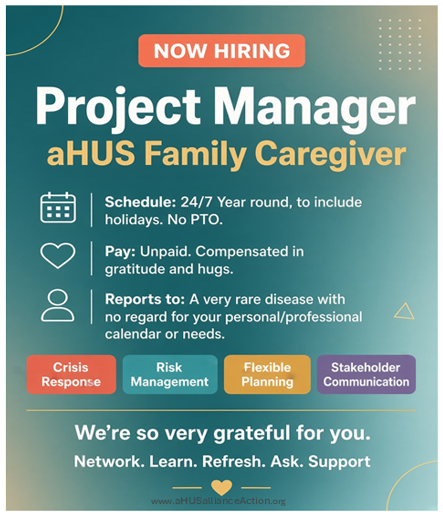
Project Manager: aHUS Family Caregiver
Position: Professional Summary
Dedicated, adaptable, emotionally invested coordinator with proven ability to manage a complex, high-stakes, rarely-seen project with zero advance notice. Thrives despite ambiguity, able to think creatively and react nimbly to situations which change rapidly. Seeking to continue making a vital difference in the life of a child, partner, relative, or friend living with atypical hemolytic uremic syndrome (aHUS).
Role & Work Details
Site: Varies. Adjusts to patient locations, to include but not limited to: home, business suites, school pickup line, medical offices, hospital rooms, trips to the pharmacy.
Schedule: 24 hrs, 7 days a week. To include weekends & holidays, no paid time off (PTO).
Compensation: Unpaid. Paid in gratitude, hugs, and other forms of appreciation. Recognizing the privilege of making a difference, and the fulfillment of knowing it mattered.
Reports to: A very rare disease, which demonstrates no regard for your personal calendar or needs.
Areas of Expertise
Risk Management: Anticipating triggers such as infection (injury, pregnancy, vaccines, certain drugs) and maintaining treatment/monitoring schedules. Following lab test protocols and vaccination schedules as indicated.
Crisis Response: Reacting to sudden, dramatic health changes caused by tiny clots in small blood vessels. Ability to convey medical history and information for physicians’ teams. Capable of communicating the need for prompt, targeted treatment of aHUS to prevent rapid disease progression.
Scheduling & Logistics: Juggling medical appointments, treatment schedules, and dietary needs while keeping vital aspects of work/school/household on track.
Stakeholder Communication: Keeping the primary medical team aware of specialist appointments and lab results. Ability to explain disease impact, to include an outward appearance does not reflect the unpredictable and serious nature of this “invisible disease” to teachers, employers, friends, and relatives.
Contingency Planning: Flexibility: Reconfiguring personal/professional/family plans, their schedules, and sometimes extended leaves on short notice.
Psychosocial Support & Resource Identification: Addressing the need to navigate anxiety, isolation, and financial strains. Researching objective, current, and relevant information matched them to patient and family needs.
Strategic Problem-Solving: Advising on constructive next steps in complex, unfamiliar, and often challenging situations by assessing the issues, identifying opportunities, and developing practical pathways toward more positive outcomes.
In the business world, the best ‘Project Managers’ do more than organize. They inspire, encourage, and keep everyone going when the road gets tough. Family caregivers certainly exemplify all the positive attributes of that description – they’re the unsung heroes managing the details, anticipating the challenges, and never losing sight of the goal: a healthier, happier life for someone they care about deeply.
To our wonderful Family Caregivers:
Your skill, your patience, and your compassionate heart are the reason so many atypical HUS patients and families feel supported and hopeful. We celebrate you, we are grateful for you, and we hope you know how much your effort matters.
National Caregivers month is recognized each November, but their dedication and the difference they make in our lives deserves to be seen and appreciated all year long. Thank you so much for all you are – and for all you do!