
When a child is diagnosed with atypical haemolytic uraemic syndrome (aHUS), also known as complement-mediated thrombotic microangiopathy (cTMA), genetic testing often follows.
Doctors look for changes (mutations) in genes that control the complement system. Sometimes the mutation appears to be brand new in the child — a “de novo” mutation — because neither parent shows a mutation on a standard blood/tissue test.
Yet in rare situations, more than one child in the same family can carry the exact same mutation.
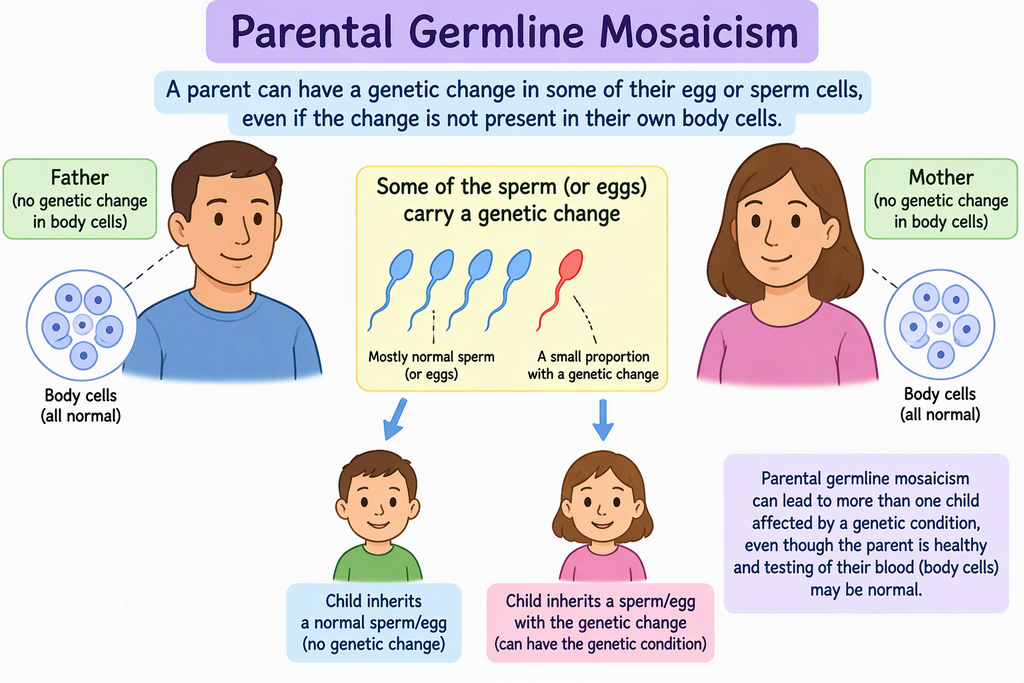
How is that possible if the parents test negative? The answer can lie in something called parental germline mosaicism.
Imagine a parent’s body as a large factory that produces eggs or sperm. Most of the factory works perfectly and produces healthy reproductive cells. But a small section of the factory may have developed a fault early in the parent’s own life. That faulty section quietly makes a few eggs or sperm that carry a genetic mutation.
Because the mutation is only present in that limited part of the reproductive system (the germline), it does not appear in the parent’s blood or other body tissues that are normally tested. The parent remains completely healthy and has no signs of aHUS.
Standard genetic tests on blood therefore come back normal. Yet there is still a small chance that an egg or sperm carrying the mutation will be used to create a child. If that happens once, the child has what looks like a de novo mutation.
If it happens more than once, two or more siblings can share the identical mutation even though both parents appear genetically clear.
How this might apply to aHUS / cTMAIn aHUS, most predisposing mutations are inherited from a parent who may never develop the disease because of incomplete penetrance (the mutation is present but does not always cause illness).
A smaller number of cases truly arise as new mutations in the affected person.When the same mutation is found in two siblings and is absent from both parents’ blood, germline mosaicism in one parent is the most likely biological explanation. It is not common, but it is possible.
This is exactly the situation that has been documented in many other genetic conditions, including neurofibromatosis, tuberous sclerosis, Marfan syndrome, osteogenesis imperfecta, and several developmental disorders like Duchenne’s Muscular Dystrophy .
Why has it not been reported in aHUS?
In a search of aHUS medical literature, no published aHUS case has yet confirmed parental germline mosaicism with molecular proof (for example, finding the mutation in a parent’s sperm or detecting it at very low levels in other tissues).
GeneReviews, a leading genetics resource, notes that while the possibility exists, no instances have been reported so far.
There are several practical reasons for this gap. aHUS is rare. Many families have only one affected child, so the pattern that raises suspicion never appears. Incomplete penetrance already makes family histories look sporadic. Deep testing of parental sperm or high-sensitivity sequencing of multiple tissues is not routine. And research attention has understandably focused on the more common patterns of inheritance and triggers.
The absence of reports does not mean the mechanism never occurs in aHUS. It simply means it has not yet been captured and published.Implications for genetic counsellingFor families, this knowledge is important but should not cause unnecessary alarm.
- If a mutation is found in a child and is clearly present in one parent, the chance of passing it on is 50% for each future pregnancy.
- If both parents test negative on standard blood testing, the chance that a future child will inherit the same mutation is low — generally estimated at less than 1%. The small residual risk exists mainly because of the theoretical possibility of germline mosaicism.
- When two children already share the same mutation and parental blood tests are negative, the residual risk is still low but is taken more seriously. Some centres may offer deeper testing or discuss options such as prenatal testing or pre-implantation genetic testing for future pregnancies.
Genetic counsellors explain these figures carefully. They stress that the absolute risk remains small and that most families in this situation go on to have healthy children. At the same time, they ensure families understand why the risk is not quite zero.
Maybe in future as genetic testing becomes more sensitive and more aHUS families are studied in depth, confirmed cases of parental germline mosaicism may eventually be reported.
Until then, the cautious approach already used in counselling — acknowledging a small residual risk — remains the right one.
In short, parental germline mosaicism is a quiet, uncommon biological possibility that helps explain rare family patterns. For aHUS families it does not change the overall picture of low recurrence risk when parents test negative, but it does remind us why careful, individualised genetic counselling matters.
Article No 832