
Keeping track of medical advancements in the rare disease space is challenging, but for those interested in atypical HUS the aHUS Alliance Global Action team ’rounds up’ new publications every few months – it’s part of our mission to *Connect *Inform *Collaborate. We’ve gathered and catorgorized research into more than a dozen scrolls, all of which lead to publications relevant to atypical hemolytic uremic syndrom (aHUS). Here are just a few we’ve highlighted, our of over 4 dozen recent additions to our aHUS ‘virtual library’ – now featuring over 1,800 entries organized by topic.
The Ayes (Eyes) Have It?
Atypical HUS isn’t only difficult to diagnose apart from other medical conditions with similar clinical symptoms, but it’s complex to treat. In part, that’s due to formation of small clots (thrombi) which can clog tiny blood vessels. When microclots block capillaries, it impedes oxygen flow to cause widespread symptoms like fatigue, brain fog, and damage to organ function. Atypical HUS can classified among conditions known as ‘primary thrombotic microangiopathy’ and sometimes referred to as complement mediated thrombotic microangiopathy (or cmTMA).
This can happen anywhere blood flows, with aHUS activity causing such microclots – and that includes the eyes. Our aHUS ‘virtual library’ of research has an entire section titled Extra Renal Manifestations featuring publications on aHUS damage involving organs other than the kidneys. For years our aHUS Alliance Global Action website offered information and articles about vision issues as one reason aHUS patients need multi-disciplinary care teams, but take a close look at this new publication on ocular manifestations:
Baker M, Ayoub M, Ghosheh T, Alnajjar Z, Alkhawaldeh M, Al-Rashdan Y, Aldabaibeh D, Al-Shami K, Karaja S. Ocular manifestations of primary thrombotic microangiopathies : a descriptive systematic review. BMC Ophthalmol. 2025 Nov 22;25(1):658. doi: 10.1186/s12886-025-04519-5. PMID: 41275116; PMCID: PMC12642294.
“We included 37 studies comprising 58 patients (mean age 18.87 ± 12.4 years), with a mean age of 18.87 years. The most common ocular manifestations were retinal hemorrhages (25.86%, n = 15), Purtscher-like retinopathy (24.13%, n = 14), retinal detachment (20.68%, n = 12),” optic disc changes (18.96%, n = 11)…”
This publication rounded up information from 37 studies, and detailed vision issues (ocular manifestations) across TMA syndrome. Included were ‘sluggish pupil reactivity’, capillary leakage, retinal ischemic changes (reduced blood supply to the retina), and fluid imbalances. Rather begs the question: If you’re living with atypical HUS, have you seen an ophthalmologist to check your vision and review the health of your eyes?
Treatment: ‘What if’ & ‘How Come’ Aspects
Out of more than 4 dozen articles we’ve just added to the topic-specific scrolls in our virtual library of aHUS research, 16 of them deal with treatment aspects.
Much remains unknown about why some people carry a genetic predisposition for aHUS activity but it never triggers into an active disease state. Still others have no family medical history noting hematology (blood) or renal (kidney) conditions, and their aHUS episode seems to occur out of the blue – termed ‘idiopathic’ or due to an unknown cause. Many knowledge gaps remain regarding genetic mutations known and involved with aHUS, as well as how they impact the health and outcomes for patients.
This recent publication joins several others on CD46 mutations, to be found in our ‘Genetics’ scroll. Figure 1: Patient History (Episodes over Time) is unique and very interesting:
Hu, B., Wang, X., Wang, X. et al. Identification of a new CD46 gene mutation site in a family with atypical hemolytic uremic syndrome. BMC Nephrol 26, 516 (2025). https://doi.org/10.1186/s12882-025-04458-9
How does the genetics of a person with atypical HUS impact their condition, and concerns such as kidney failure or relapse risks? The Global aHUS Registry has a large data base, organized by nation, and a publication about Belgian patients was recently released.
Massart, A., Weekers, L., Claes, K.J. et al. Clinical and genetic characteristics of patients diagnosed with atypical hemolytic uremic syndrome (aHUS): epidemiological data from the Belgian cohort of the Global aHUS Registry. J Nephrol (2025). doi.org/10.1007/s40620-025-02366-7
Of particular interest regarding the 121 patients in this Belgian group, the overall data noted a prevalence of 10.4 patients per million(somewhat high compared to estimates in other countries) and with data that indicated an ‘increased susceptibility of women to aHUS’ across known complement variants. “Further research is warranted to understand the gender-specific risk factors for aHUS in women.” was the concluding statement in this publication
Future Considerations: aHUS Treatment Topics
Many of us used to think of medicine as a black-and-white scientific process, where a condition was diagnosed and the clinician followed a clear pathway to treat anyone with that set of symptoms and/or lab values. The reality is more a spectrum of gray tones, particularly in the case of aHUS diagnosis and treatment.
Atypical HUS research has evolved, but still points to a complex disease with many different patient profiles. Evidence now suggests that aHUS isn’t one single disorder but a group of rare conditions most often characterized by uncontrolled complement system activation, leading to tiny blood clots which cause organ damage. Arguably, data sets seem to be falling into 3 main subtypes of aHUS, organized by root cause: Genetic aHUS (mutations in complement genes like CFH, CFI, C3), Trigger-Induced aHUS (secondary to infections, drugs, pregnancy, autoimmune issues), and a scattering of variations such as Metabolic aHUS (like DGKE mutations) or blends with other overlapping causes.
Here’s the question to ponder: Since some aHUS subtypes don’t have a complete response to current therapeutic drugs, how can we better identify what treatment plan will be best for each individual?
Barratt J, Garred P, Lafayette RA, Zhang H, Floege J. Complement-Mediated Kidney Diseases: Role of Alternative Pathway in Glomerular Inflammation. Kidney Intn’l Reports, 2025, ISSN 2468-0249. doi.org/10.1016/j.ekir.2025.11.029.
Advancement in treatment for diseases sharing some similarities with atypical HUS may provide insights into emerging new drugs to add to existing ones. As noted by Bomback et al in their 2016 publication Complement-Mediated Glomerular Diseases: A Tale of 3 Pathways, “The C3 glomerulopathies overlap with atypical hemolytic uremic syndrome (aHUS, also termed complement-mediated thrombotic microangiopathy) in genetic abnormalities (e.g., mutations in factor H, factor I, membrane cofactor protein, C3, and factor B) and autoantibodies” they clarify, “Yet, aHUS differs from the C3 glomerulopathies where the alternative pathway dysregulation occurs.”
At the heart of this topic? Personalized treatment that is safe and effective, by tailoring the management of aHUS to address each patient’s individual needs. That’s key, the ‘right’ treatment for the ‘right’ duration of time to not only resolve aHUS activity happening in the present but to diminish any relapse risks in the future.
Both the Dutch and the UK have looked at the concept of optimal treatment duration for complement inhibitor eculizumab, and how various factors must figure in to deciding when/if to stop infusions. Published in September 2025, Bryant el al provided data and insights within their multi-center trial Eculizumab withdrawal and monitoring in atypical haemolytic uraemic syndrome (SETS aHUS).
This article teases out specifics which highlight the factors involved in withdrawing treatment, drawing upon the rich data from the SETS aHUS trial in the UK:
Lecouturier J, Sheerin N. Which Factors Influence Decisions to Withdraw from Eculizumab: A Qualitative Study of Patients Diagnosed with aHUS. Patient. 2025 Sep 12. doi: 10.1007/s40271-025-00771-5. (PDF Download. Epub ahead of print. PMID: 40940630.)
Our aHUS Alliance Global Action team has explored the concept of ‘the right drug for the right duration’ as well as the patient viewpoint of discontinuation concerns in many of our website articles, a partial list of which can be viewed HERE.
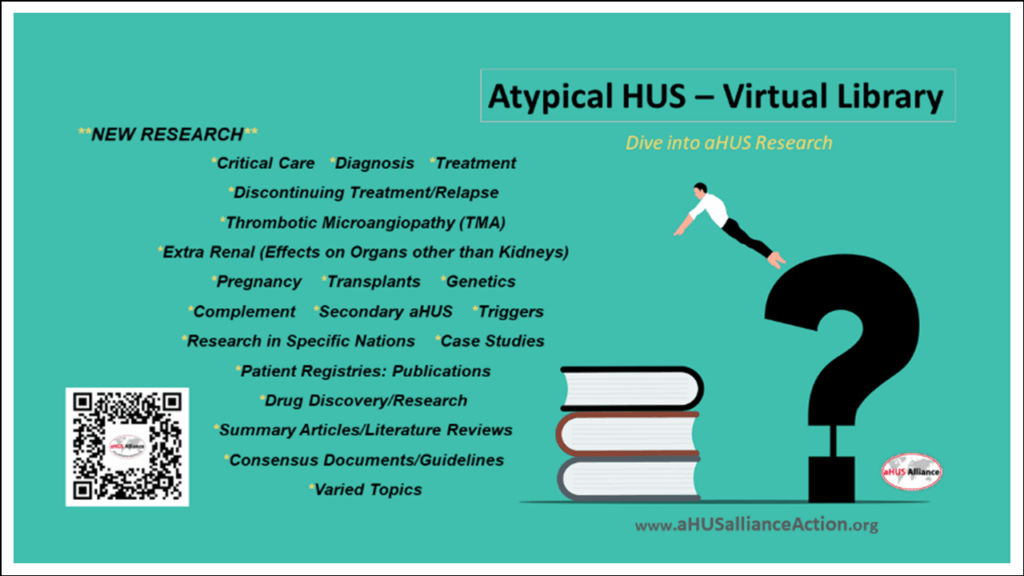
A ‘Virtual Library’ of aHUS-specific Research – What is that?
Often publications with advancements and insights into this very rare disease are scattered across medical journals related to nephrology and hematology specialties, but atypical HUS information can be found under varied terms and across specialty areas. That’s where we come in, since as aHUS patients and family caregivers ourselves we have a vested interest in staying up-to-date with current research. It’s likely that other families affected by aHUS may wish to key into a specific topic, so to aid navigation of our ‘Research and Publications’ page we’ve not only categorized entries but also have added links to jump to each Scroll (topic section) to speed your search.
Research articles about atypical HUS are listed within our website on topic-specific lists within our Info Centre, where you can see a list for “New Research” which are then also listed by category.
Visit our ‘virtual library’ of almost 1,600 publications specific to aHUS
by clicking this link: Atypical HUS Research & Publications
(Note: All entries from the ‘New Research’ scroll additionally are cross-listed at the start of each specific topic. While this ‘library’ has grown to over 1,600 unique publications, it results in over 1800 due to dual entries – such as a study that examines mutation impact on disease management, and thus listed on both Genetics and Treatment scrolls.)
Keeping Pace with Advancements: Are you ‘aHUS Aware’?
The aHUS Alliance Global Action team encourages researchers to release their studies and publications in full text versions, with Open Access to facilitate sharing knowledge. Additionally, we welcome and applaud those individuals and groups who include “Plain Language Versions” as part of their publication’s Supplementary Materials.
Are you staying current with aHUS research & News?
We invite you to subscribe to our free newsletter, The aHUS Global Advocate
For More about our Newsletter & reasons to Stay Connected
Click Here to Sign Up to receive the Newsletter