
Atypical Hemolytic Uremic Syndrome – a Rare Disease
Solid, independent information on this rare disease is genuinely hard to find, and the science behind it keeps shifting as new research fills in the gaps. Add to that the fact that atypical HUS presents differently from patient to patient, even for those with similar genetic profiles, and it’s easy to see why staying informed takes real effort. That’s exactly why the aHUS Alliance Global Action team has since 2016 updated our Fact Sheet each year: to give patients, families, and caregivers a trusted, current resource in one place.
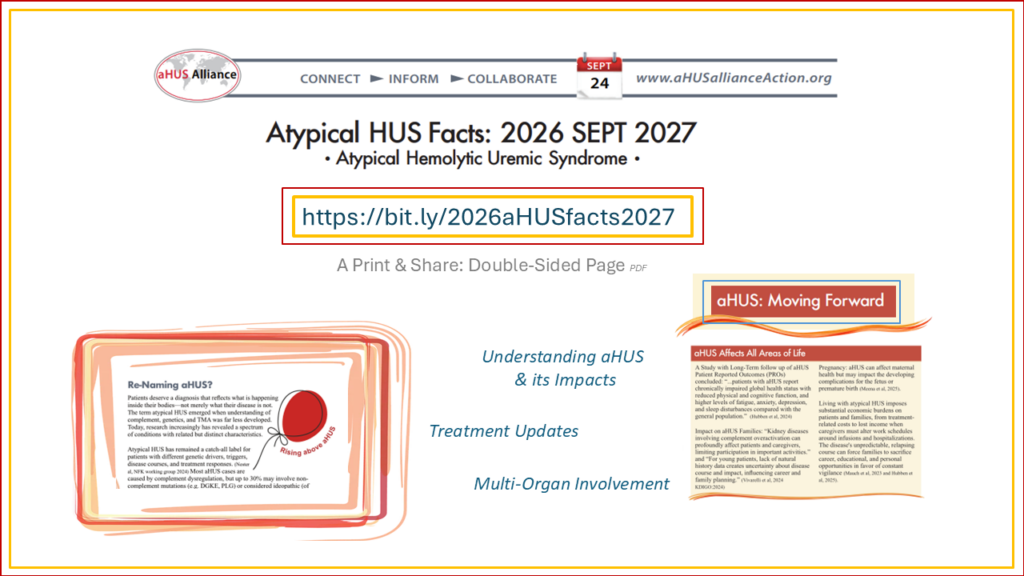
As aHUS clinical practice and research has evolved, our newest edition of the Atypical HUS Fact Sheet (2026-Sept-2027) distills the essentials of atypical hemolytic uremic syndrome into one printer-friendly, double-sided PDF — accurate, current, and easy to share.
New findings continue to reshape what we know about diagnosis, treatment, and outcomes, and because the aHUS is unpredictable in its severity and organs affected, staying current isn’t optional — it’s essential.
CLICK HERE to Read & Print our
Atypical HUS Fact Sheet: 2026 – SEPT – 2027 (pdf)
Share the direct Link: https://bit.ly/2026aHUSfacts2027
To the physicians and nurses whose compassion helps patients and families find their footing after a life-threatening diagnosis — thank you. To the doctors who take the time to mentor the next generation and share their expertise at conferences and webinars — your generosity ripples outward in ways you may never fully see. And to the research teams working tirelessly toward new therapeutic options — thank you for giving our community reason to hope. (You’ll see a list of publications used in the 2026-Sept-2027 Fact Sheet cited at the end of this article.)
But most of all, we honor the aHUS patients, caregivers, and families who rise each day with courage and grace, who refuse to let this disease define their limits, their dreams, or their goals. Together, united in advocacy, we can build a brighter tomorrow — one filled with knowledge, compassion, and hope.
Don’t miss these Highlights – Visit & Learn More:
Atypical HUS Research & Publications – a ‘Virtual Library’, organized by Topic
RESOURCES & Key Assets – An index to Information, Networks, and Articles
Know aHUS: Know Us – Available n 4 languages (EN, FR, ES, PT) , it’s ‘plain language’ overview of atypical HUS & how it affects the lives of patients and their families. Print & Share (pdf) with friends and family – or at work or school.
Interested in atypical HUS Facts & ready to dive into Research?
Here are the publications referenced to create our 2026 – Sept – 20257 aHUS Fact Sheet, with our sincere appreciation to the many esteemed clinicians, researchers, and other authors for such meaningful work.
RESEARCH Citations within the Fact Sheet: listed Alphabetically
Alyamany R, Moyer AM, Willrich MAV, Sridharan M. Complement-mediated HUS revisited: evolving insights into pathophysiology, diagnosis, and treatment. Front Immunol. 2026 Jan 14;16:1621317. doi: 10.3389/fimmu.2025.1621317. PMID: 41613109; PMCID: PMC12847932.
Bettoni S, Qviberg E, Chaloner E, Lavender H, Laabei M. Complement Inhibition in the Clinic: Are We Doing Enough to Protect Patients From Infection? Eur J Immunol. 2026 Jul;56(7):e70233. doi: 10.1002/eji.70233. PMID: 42387937; PMCID: PMC13324233.
Bogdan RG, Anderco P, Ichim C, Cimpean AM, Todor SB, Glaja-Iliescu M, Crainiceanu ZP, Popa ML. Atypical Hemolytic Uremic Syndrome: A Review of Complement Dysregulation, Genetic Susceptibility and Multiorgan Involvement. J Clin Med. 2025 Apr 7;14(7):2527. doi: 10.3390/jcm14072527. PMID: 40217974; PMCID: PMC11989465.
Bryant A, Lecouturiera J, Orozco-Leala G, Brocklebank V, Carnellb S, Chadwicka T, Dunn S, Johnson S, Kavanagh D, Kennedy C, Malina M, Montgomery E, Muirheada C, Oluboyedea Y, Valea L, Weetmana C, Wong E, Sheerin N, SETS aHUS Consortium. Eculizumab withdrawal and monitoring in atypical haemolytic uraemic syndrome (SETS aHUS): a multicentre, open label, prospective, single arm trial. The Lancet, Volume 56, 101392. September 2025. doi: 10.1016/j.lanepe.2025.101392.
Bryant A, Lecouturier J, Orozco-Leal G, Brocklebank V, Carnell S, Chadwick TJ, Dunn S, Johnson SA, Kavanagh D, Kennedy CA, Malina M, Montgomery EK, Muirhead CR, Oluboyede Y, Vale L, Weetman C, Kwan Soon Wong E, Woodward L, Sheerin NS. Clinical and cost-effectiveness of eculizumab withdrawal in atypical haemolytic uraemic syndrome: the SETS aHUS multi-centre, open-label, prospective and single-arm study. Health Technol Assess. 2026 Feb;30(20):1-37. doi: 10.3310/GJNS4701. PMID: 41772879; PMCID: PMC12969051.
Bouwmeester RN, Engel LJ, Altena W, Renette C, van Daelen C, van Kempen E, de Wildt R, van de Kar NCAJ. Living with Atypical Hemolytic Uremic Syndrome in the Netherlands: Patient and Family Perspective. Kidney Int Rep. 2024 Apr 27;9(7):2189-2197. doi: 10.1016/j.ekir.2024.04.047. PMID: 39081735; PMCID: PMC11284443.
Brocklebank V, Walsh PR, Smith-Jackson K, Hallam TM, Marchbank KJ, Wilson V, Bigirumurame T, Dutt T, Montgomery EK, Malina M, Wong EKS, Johnson S, Sheerin NS, Kavanagh D. Atypical hemolytic uremic syndrome in the era of terminal complement inhibition: an observational cohort study. Blood. 2023 Oct 19;142(16):1371-1386. doi: 10.1182/blood.2022018833. PMID: 37369098; PMCID: PMC10651868.
Cole MA. Update in the diagnosis of complement-mediated thrombotic microangiopathy/ atypical hemolytic uremic syndrome. Hematology Am Soc Hematol Educ Program. 2025 Dec 5;2025(1):164-175. doi: 10.1182/hematology.2025000702. PMID: 41347971; PMCID: PMC12891352.
Fakhouri F, Schwotzer N, Frémeaux-Bacchi V.. How I diagnose and treat atypical hemolytic uremic syndrome. Blood. 2023 Mar 2;141(9):984-995. doi: 10.1182/blood.2022017860. PMID: 36322940.
Formeck C, Swiatecka-Urban A. Extra-renal manifestations of atypical hemolytic uremic syndrome. Pediatr Nephrol. 2019 Aug;34(8):1337-1348. doi: 10.1007/s00467-018-4039-7. Epub 2018 Aug 14. PMID: 30109445; PMCID: PMC8627279.
Hockman A, Anuskiewicz S, Brennan E, Chowdhury SR, Coltoff A, Poston JN, Greenberg C, Djulbegovic B. Efficacy of eculizumab discontinuation in atypical hemolytic uremic syndrome: a systematic review and meta-analysis. Blood Adv. 2025 Dec 9;9(23):6096-6107. Erratum: Blood Adv. 2026 Jun 23;10(12):4183. doi: 10.1182/bloodadvances.2026020871. PMID: 40795230; PMCID: PMC12719173
Hubben A, Brown J, Burke L, Woodward L, Martin C, McCrae K, Chaturvedi S. Patient Reported Outcomes during Long-Term Follow-up of Atypical Hemolytic Uremic Syndrome in the Era of Terminal Complement Inhibition. Blood, Volume 144, Supplement 1, 2024, ISSN 0006-4971, doi.org/10.1182/blood-2024-200224.
Java A. Atypical hemolytic uremic syndrome: diagnosis, management, and discontinuation of therapy. Hematology Am Soc Hematol Educ Program. 2024 Dec 6;2024(1):200-205. doi: 10.1182/hematology.2024000543. PMID: 39644051; PMCID: PMC11665500.
Kavanagh D, Goodship TH, Richards A. Atypical hemolytic uremic syndrome. Semin Nephrol. 2013 Nov;33(6):508-30. doi: 10.1016/j.semnephrol.2013.08.003. PMID: 24161037; PMCID: PMC3863953.
Lemaire M, Frémeaux-Bacchi V, Schaefer F, Choi M, Tang WH, Le Quintrec M, Fakhouri F, Taque S, Nobili F, Martinez F, Ji W, Overton JD, Mane SM, Nürnberg G, Altmüller J, Thiele H, Morin D, Deschenes G, Baudouin V, Llanas B, Collard L, Majid MA, Simkova E, Nürnberg P, Rioux-Leclerc N, Moeckel GW, Gubler MC, Hwa J, Loirat C, Lifton RP. Recessive mutations in DGKE cause atypical hemolytic-uremic syndrome. Nat Genet. 2013 May;45(5):531-6. doi: 10.1038/ng.2590. Epub 2013 Mar 31. PMID: 23542698; PMCID: PMC3719402.
Licht C, Ardissino G, Ariceta G, Cohen D, Gasteyger C, Greenbaum L, Ogawa M, Varant Kupelian V, Schaefer F, Vande Walle J, Véronique Frémeaux-Bacchi V. The Global aHUS Registry: Characteristics of 826 Patients with Atypical Hemolytic Uremic Syndrome. Blood (2015) 126 (23): 4640. doi.org/10.1182/blood.V126.23.4640.4640
Licht C, Al-Dakkak I, Anokhina K, Isbel N, Frémeaux-Bacchi V, Gilbert R, Greenbaum L, Ariceta G, Ardissino G, Schaefer F, Rondeau E. Characterization of patients with aHUS and associated triggers or clinical conditions: A Global aHUS Registry analysis. Nephrology. 2024; 29(8): 519-527. doi:10.1111/nep.14304
Mauch TJ, Chladek MR, Cataland S, Chaturvedi S, Dixon BP, Garlo K, Gasteyger C, Java A, Leguizamo J, Lloyd-Price L, Pham TP, Symonds T, Tomazos I, Wang Y. Treatment preference and quality of life impact: ravulizumab vs eculizumab for atypical hemolytic uremic syndrome. J Comp Eff Res. 2023 Sep;12(9):e230036. doi: 10.57264/cer-2023-0036. Epub 2023 Jul 29. PMID: 37515502; PMCID: PMC10690411.
Meena P, Gala R, Das RR, Bhargava V, Saivani Y, Panda S, Mantri A, Agrawaal KK. Kidney and pregnancy outcomes in pregnancy-associated atypical hemolytic uremic syndrome: A systematic review and meta-analysis. Medicine (Baltimore). 2025 Jan 31;104(5):e41403. doi: 10.1097/MD.0000000000041403.
Nester CM, Feldman DL, Burwick R, Cataland S, Chaturvedi S, Cook HT, Cuker A, Dixon BP, Fakhouri F, Hingorani SR, Java A, van de Kar NCAJ, Kavanagh D, Leung N, Licht C, Noris M, O’Shaughnessy MM, Parikh SV, Peyandi F, Remuzzi G, Smith RJH, Sperati CJ, Waldman M, Walker P, Vivarelli M. An expert discussion on the atypical hemolytic uremic syndrome nomenclature-identifying a road map to precision: a report of a National Kidney Foundation Working Group. Kidney Int. 2024 Sep;106(3):326-336. doi: 10.1016/j.kint.2024.05.021. PMID: 39174192.
Noris M, Bresin E, Mele C, et al. Genetic Atypical Hemolytic-Uremic Syndrome. Updated 2021 Sep 23. In: Adam MP, Bick S, Mirzaa GM, et al., editors. GeneReviews® [Internet]. Seattle (WA): University of Washington, Seattle; 1993-2026.
Raina R, Krishnappa V, Blaha T, Kann T, Hein W, Burke L, Bagga A. Atypical Hemolytic-Uremic Syndrome: An Update on Pathophysiology, Diagnosis, and Treatment. Ther Apher Dial. 2019 Feb;23(1):4-21. doi: 10.1111/1744-9987.12763. Epub 2018 Oct 29. PMID: 30294946.
Rondeau E, Ardissino G, Caby-Tosi MP, Al-Dakkak I, Fakhouri F, Miller B, Scully M; Global aHUS Registry. Pregnancy in Women with Atypical Hemolytic Uremic Syndrome. Nephron. 2022;146(1):1-10. doi: 10.1159/000518171. Epub 2021 Sep 7. PMID: 34515154; PMCID: PMC8820436.
Simons M, Hoefele J. Genetic kidney diseases – from discovery to precision care. Med Genet. 2026 Feb 18;38(1):1-2. doi: 10.1515/medgen-2025-2049. PMID: 41710421; PMCID: PMC12910340.
Spasiano A, Palazzetti D, Dimartino L, Bruno F, Baccaro R, Pesce F, Grandaliano G. Underlying Genetics of aHUS: Which Connection with Outcome and Treatment Discontinuation? Int J Mol Sci. 2023 Sep 24;24(19):14496. doi: 10.3390/ijms241914496. PMID: 37833944; PMCID: PMC10572301.
Tohidi, M., Mohammadi, M. A review of genetic and epigenetic biomarkers involved in the occurrence of atypical hemolytic uremic syndrome and its therapeutic strategies. Mol Biol Rep 53, 760 (2026). doi.org/10.1007/s11033-026-11912-w
Vivarelli M, Barratt J, Beck LH Jr, Fakhouri F, Gale DP, Goicoechea de Jorge E, Mosca M, Noris M, Pickering MC, Susztak K, Thurman JM, Cheung M, King JM, Jadoul M, Winkelmayer WC, Smith RJH; for Conference Participants. The role of complement in kidney disease: conclusions from a Kidney Disease: Improving Global Outcomes (KDIGO) Controversies Conference. Kidney Int. 2024 Sep;106(3):369-391. doi: 10.1016/j.kint.2024.05.015. PMID: 38844295.
Vujović A, Sellier-Leclerc AL, Mancuso MC, Boyer O, Awan A, Gargiulo A, Loos S, Fila M, Jankauskiene A, Ariceta G, Kanzelmeyer N, Vidal E, Van Dyck M, Levart TK, Šimánková N, Decramer S, Hofstetter J, Vivarelli M, Sciascia S, van de Kar NCAJ, Schaefer F; ERKNet TMA Working Group. Real-world use of complement inhibitors for haemolytic uraemic syndrome: an analysis of the European Rare Kidney Disease Registry cohort. EClinicalMedicine. 2025 Mar 27;82:103159. doi: 10.1016/j.eclinm.2025.103159. PMID: 40224677; PMCID: PMC11987679.
Westra D, Volokhina E.B., van der Molen, R.G. et al. Serological and genetic complement alterations in infection-induced and complement-mediated hemolytic uremic syndrome. Pediatr Nephrol 32, 297–309 (2017). https://doi.org/10.1007/s00467-016-3496-0
Yerigeri K, Kadatane S, Mongan K, Boyer O, Burke LLG, Sethi SK, Licht C, Raina R. Atypical Hemolytic-Uremic Syndrome: Genetic Basis, Clinical Manifestations, and a Multidisciplinary Approach to Management. J Multidiscip Healthc. 2023 Aug 4;16:2233-2249. doi: 10.2147/JMDH.S245620. PMID: 37560408; PMCID: PMC10408684.