
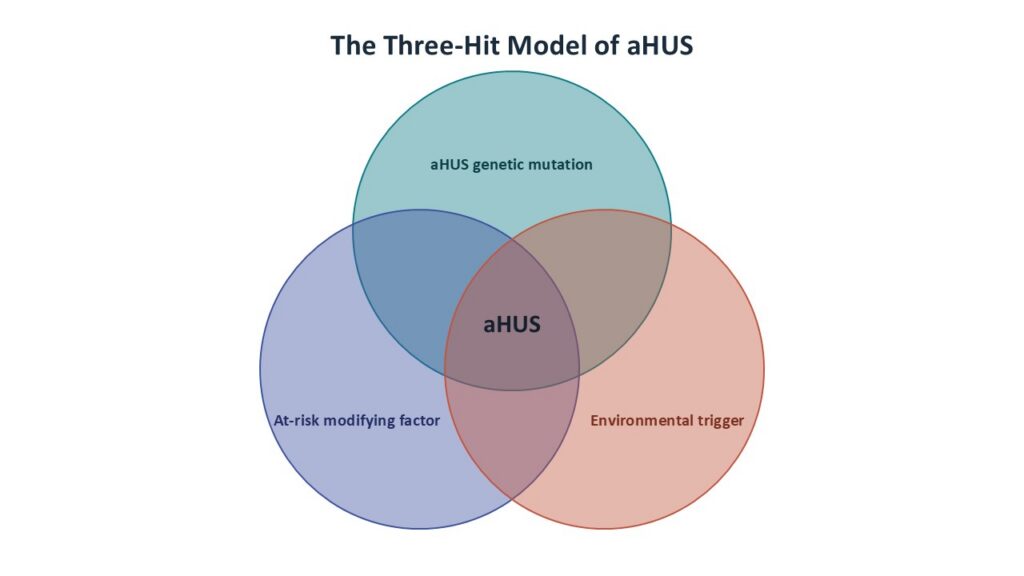
Although it is thought it might, aHUS does not always happen. It needs 3 hits.
It is known that aHUS is multifactorial: rare pathogenic variants in complement genes (e.g., CFH, CFI, CD46, C3, CFB) create a predisposition but with an incomplete penetrance.
Common risk haplotypes act as modifiers that can increase disease risk, severity, or penetrance, especially when combined with rare variants and/or “environmental” triggers such as infection, pregnancy, etc.
It has been known for a long time that molecular testing should include analysis of genetic modifiers, including CFHR3/CFHR1 deletion analysis and the CFH-H3 and CD46 (MCP)-GGAAC haplotypes. It is mentioned in this article in 2007.
These haplotypes (together with triggers) may increase penetrance. Third of 3 hits.
KDIGO Controversies Conference in 2022 conclusions similarly noted that genotyping should include the risk haplotypes CFH-H3 and MCP ggaac because of the frequent concurrence of genetic risk factors.
Leading clinical laboratories (e.g., Mayo Clinic Laboratories aHUS/TMA/C3G panel) explicitly report the CFH-H3 risk haplotype and MCP/CD46 risk haplotype as part of their panels.
These are common in the general population but, in the right genetic/environmental context, associate with increased risk of development or progression of aHUS. Some panels also cover related risk alleles or C5 variants linked to eculizumab response.
Other specialized panels and research/clinical cohorts routinely assess these haplotypes (along with CFHR copy-number variants) for a fuller picture of susceptibility.
Though not every basic or minimal gene panel reports haplotypes by default (some focus primarily on rare pathogenic variants + CFHR3-CFHR1 deletions).
However, guidelines and expert sources treat haplotype analysis as an important component of thorough testing rather than optional.
It matters because aHUS shows incomplete penetrance in families and variable occurrence. Counselling is more accurate when it incorporates the full genetic background.
Risk haplotypes help explain why some carriers of rare variants develop disease while relatives do not, or why disease severity varies.
They inform discussions of recurrence risk, transplant considerations, and potential triggers like pregnancy.
Alone they do not “cause” aHUS (they are common polymorphisms/risk factors), so counselling must carefully distinguish them from high-penetrance pathogenic variants and emphasize the multifactorial nature of the disease.
For optimal aHUS genetic counselling, testing should ideally include (or explicitly assess) the recognized at-risk haplotypes (CFH-H3 and MCP/CD46-GGAAC) in addition to sequencing of core genes, copy-number analysis of the CFH-CFHR region, and anti-CFH autoantibody testing.
So the specific panel used with the ordering laboratory or a genetics specialist experienced in complement disorders, as reporting practices can vary. Results should always be interpreted in the full clinical context by experts familiar with aHUS genetics. If not then wrong conclusions may result when aHUS may not happen in some people.
3 hits are needed for something to happen.
Article No: 811