
It is clear that amongst the hullabaloo about aHUS renaming it was not those aHUS persons with known complement mutations, or autoantibodies or non complement mutations hampering complement who were at risk from a change. If anything it was advantageous for them as their disease’s cause was evidently complement mediated thrombotic microangiopathy.
No it was those diagnosed with aHUS but with no evident reason for a vulnerability to it but who on occasions seemed to respond to complement treatment in the acute phase of a TMA onset.
It was said about them that their mutation had not been found yet. That is very plausible. All known mutations were once not known.
However it is known that some patients have a link to other TMAs which can kick off over activating complement. So cTMA can be secondary to that first TMA hit. In secondary hemolytic uremic syndrome (HUS), TMA is caused by drugs, infectious agents, immune complexes, antibodies, and proinflammatory/procoagulant cytokines that directly damage the endothelium cells in the lining of blood vessels Genetic abnormalities or autoantibodies are not usually found in secondary HUS (1) , But complement can still be over activated maybe in a small number of cases because of ineffective controls in the patient’s complement system
Or more likely there is an overwhelming amplification of complement beyond the capability of the persons working complement controls to cope with. This can happen to anyone.
So we have this situation:
| Genetic | Non-Genetic | |
| Complement TMA | Pure aHUS | Not found |
| Non- complement TMA | Secondary | Not aHUS |
In three of those four scenarios complement inhibition can help but in some cases may not be needed for long.
There is also a lot of uncertainty of the proportions of patients that fit into those categories.
The incidence and prevalence rates of complement and non complement TMAs can be woefully uncalculated or miscalculated. Mainly because the science cannot say with any precision which is which. This was a worry for name change that could not be precise at present.
One of the best sources of aHUS information (and it is not because it is where the author is from) is the National Renal Complement Therapeutics Centre in Newcastle upon Tyne, UK. This hospital has had over fifty years of experience of research into aHUS. Its annual report is a goldmine of information about sHUS. (2) Along with other centres around the world it is Global Centre of Excellence.
Its annual reports are a must read for UK aHUS patients and others could learn a lot about aHUS from reading them. To the best of the author’s knowledge the reports are unique.
So look at the annual diagnosis and treatment data from 2016/17 to 2023/24. From all suspected aHUS TMA referrals from other hospitals around England through the diagnosis decision and eculizumab prescriptions ( which Newcastle pays for) to the treatment status at the end of each each year. These figures would exclude the TTP numbers ( TTP has its own expert centres) and the STEC HUS diagnosed.
The table below gives the figures for the 8 years.
Analysis of referrals and how they were managed – (eculizumab is the drug prescribed)
| 12 months | All TMAs Referred | Not prescribed* | Prescribed | Stopped | Withdrawn Failed | Continued |
| 2016/17 | 65 | 33 | 32 | 9 | 3 | 20 |
| 2017/18* | 115 | 77 | 38 | 11 | 10 | 17 |
| 2018/19* | 143 | 107 | 36 | 9 | 11 | 16 |
| 2019/20* | 199 | 163 | 36 | 8 | 13 | 15 |
| 2020/21 | 221 | 199 | 22 | 8 | 9 | 5 |
| 2021/22 | 230 | 192 | 38 | 13 | 6 | 19 |
| 2022/23 | 249 | 209 | 40 | 8 | 5 | 27 |
| 2023/24 | 253 | 224 | 29 | 4 | 13 | 12 |
| Total | 1475 | 1204 | 271 | 70 | 70 | 131 |
*excludes preapproved patients awaiting a kidney transplant operation
Of the 1475 suspected cases of aHUS only 271 eculizumab treatment prescriptions were issued. Of them only 131 patients remained on treatment at the end of each 12 months- an average of 14 per year. 70 prescriptions were ended because chronic kidney failure was diagnosed or another diagnosis was found. 70 prescriptions were stopped because treatment was no longer needed (a discontinuation rate of almost 25%) . 1204 patients, or around 80% of those suspected were deemed to not have aHUS, or the complement mediated version of it.
A deeper dig into the data about the referred patients to show the distributions of genetic mutations found.
The genetic status of suspected aHUS patient referrals and treatments
| Mutation | All TMAs Referred | Not prescribed* | Prescribed | Stopped | Withdrawn Failed | Continued |
| CFH | 46 | 8 | 38 | 2 | 4 | 32 |
| CFI | 17 | 7 | 10 | 1 | 4 | 5 |
| CD46 | 44 | 27 | 17 | 1 | 1 | 15 |
| C3 | 18 | 3 | 15 | 2 | 1 | 12 |
| AFHA | 42 | 15 | 27 | 0 | 1 | 26 |
| No mutation determined | 1295 | 1141 | 154 | 62 | 56 | 36 |
| Inf | 4 | 0 | 4 | 0 | 0 | 4 |
| DGKE | 7 | 2 | 5 | 2 | 2 | 1 |
| AdamTS13 | 1 | 0 | 1 | 0 | 1 | 0 |
| MACHA | 1 | 1 | 0 | 0 | 0 | 0 |
| 1475 | 1204 | 271 | 70 | 70 | 131 |
Of 1475 referrals 1141 patients were found to have no detectable genetic mutation or acquired autoantibodies, roughly 82%. Most were not prescribed treatment as the elaborate diagnosis protocol used by the centre deemed them not to have aHUS. 271were prescribed eculizumab including 154 with no mutation determined but by the end of each year only 32 of the 154 remained on treatment as a completement inhibitor was no longer needed for others. The no mutation determined group represented 88% of all of the 70 who were deemed to longer need eculizumab.
The data also permits an attempt at filling in the table at the beginning of the article:
| Genetic | Not genetic | |
| Complement TMA | Pure aHUS = 117 | Not Found= 154 |
| Non complement TMA | Secondary aHUS =63 | Not aHUS= 1141 |
Or in proportion in a pie chart.
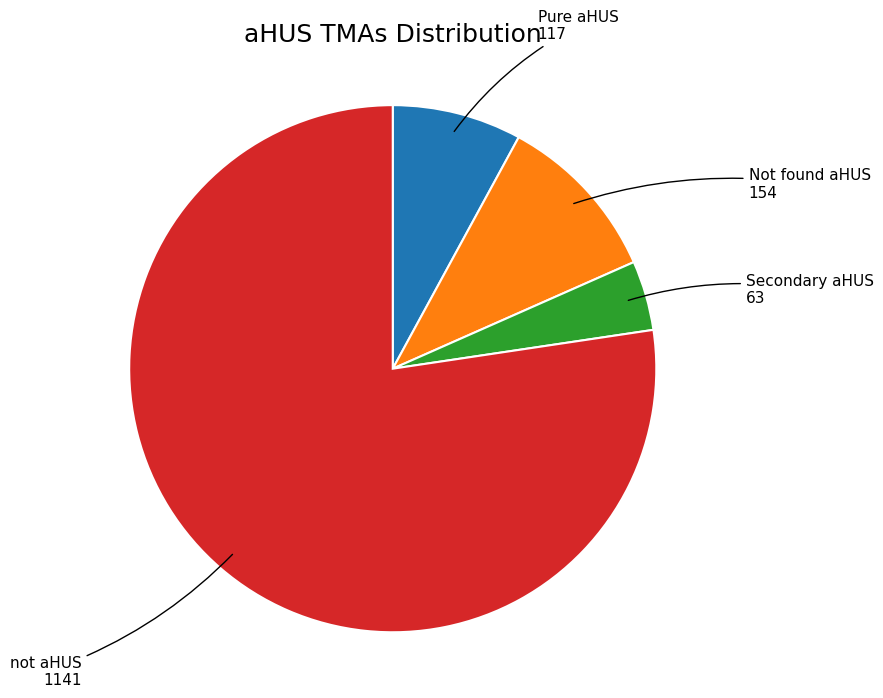
The genetic to no genetic vulnerability ratio is 54:46 which is not untypical.
However if the diagnosis accuracy of this aHUS Expert Centre is accepted there are almost 3 times the likely aHUS cases which are deemed not aHUS, even without the TTP and STEC HUS TMAs that would not have been referred to Newcastle included . Or any TMAs not identified in the base hospitals unreferred.
However in secondary aHUS some research has found that often complement is activated in far higher numbers without a genetic mutation. So how many of the 1141 other TMAs without known mutations could have been temporarily setting off complement over activation.
Furthermore how many of the not aHUS patients in less expert situations would have been unnecessarily treated with a complement inhibitor. Even more so how many of those who could stop treatment but remain on infusions.
The data is limited because there is no indication of the diagnosis process timeline or the health outcomes of each patient. COVID impact on hospital service for some of the years. It does not include data for complement inhibitor supported transplant. Or is confined to 12 month block wit out knowing happened subsequently.
But for now this initial data shows the challenge of getting to personalised medicine. Getting enough medicine when needed for as long as is needed.
Article No. 826
T