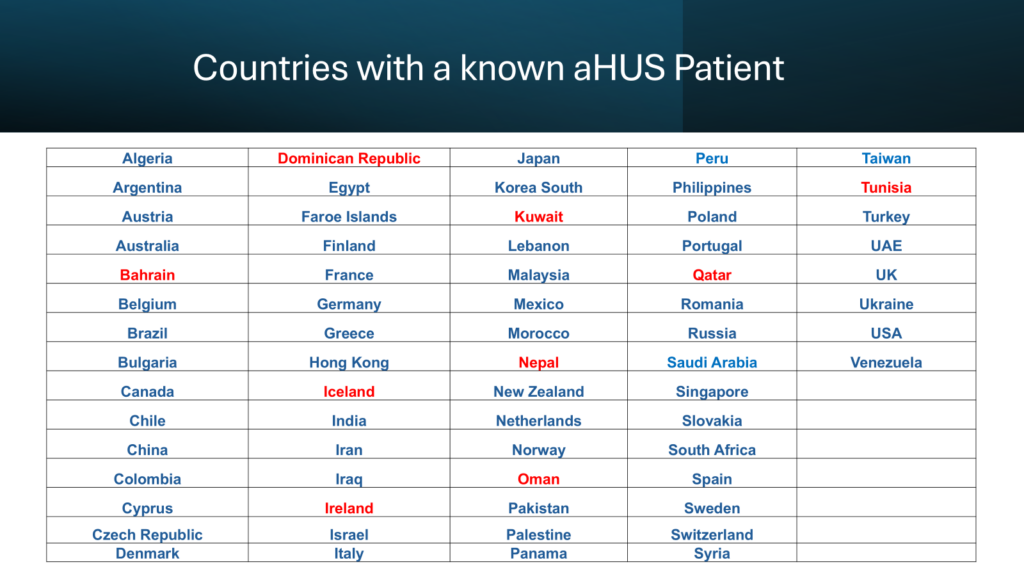
Since our last report on Global aHUS Town very little has changed in the number of countries who are now aHUS neighbours.
But recently more have come to our attention, Someone from the Dominican Republic told us about the difficult situation there for accessing effective complement inhibitors. This is a recurrent problem for low resource countries.
Resources is less of a problem for oil rich states in the Middle East. Patients with aHUS from Saudi Arabia and UAE are known to us for several years now but a recent article revealed that there are aHUS patients in QATAR, OMAN, KUWAIT and BAHRAIN.
The article was about a conference in which the “Gulf Cooperating Countries” examine the gaps and priorities for aHUS in that region of the world.
It focussed not on the availability of eculizumab and ravulizumab but on the economic and operational burden of using them in their healthcare systems. They discussed healthcare resource utilization value for payers, clinical and economic burden of the disease itself and what happens else where in the world. They found needs for establishing incidence and prevalence of the disease, quantifying use and costs, knowing treatment patterns and outcomes from a multi centre study. Also a need for looking back at patients data and see what happened and the results from follow up and establish unified data across the region.
From the payers point view making decisions what can be sustainable, equitable and value based. This is not taking away funding from aHUS patients but finding ways to ensure that all patients receive the treatment they need for as long as they need it. No waste and optimal outcomes.
This is the citation for the conference article:
Abu Esba LC, AlMardawi GH, Alhenaidi A, Ahmed M, AlShehry AO, Al Naeem W, Alshara Q, Alkandari O, Al-Omar HA. Research Gaps and Priorities for aHUS in the Gulf Cooperation Countries (GCC): Findings from a Payer-Focused Expert Meeting. Clinicoecon Outcomes Res. 2026;18:595064 https://doi.org/10.2147/CEOR.S595064
So another five neighbours move into town bring the current total to 68.
The countries in red have been added since the project began.
Article No. :805